

C.7 · 03 awnings & outdoor
Outdoor blinds or awnings: picking the right shade for longer spring evenings
If you want the patio usable after dinner this spring, the choice comes down to whether you need fixed overhead cover or a wall you can drop and lift, and the side of the house decides most of it.
Blinds or awnings: the short answer
Stand on your patio at 6pm and look at where the sun is. If it is above you and the problem is heat and glare from overhead, you want an awning: fixed or folding-arm cover that shades from the top. If the sun is coming in sideways under the roofline, low and orange and straight into everyone's eyes, an awning will not help much. That is a job for outdoor blinds, which drop vertically down the open side and roll back up when you want the view.
Plenty of houses here need an awning on one side and a blind on the next. So the useful question is not which product is better. It is which direction each problem arrives from.
This matters now because the evenings are about to get longer twice over. Australia's meteorological spring runs 1 September to 30 November, a fixed calendar definition the Bureau uses because it fits our temperature patterns better than the equinox. On top of that, NSW daylight saving starts at 2:00am on Sunday 4 October 2026, when clocks move forward an hour to 3:00am. The Reserve Bank's official schedule lists the same date and mechanism.
What each one actually does
| Fixed awning | Retractable folding-arm awning | Café-style outdoor blind | |
|---|---|---|---|
| Direction of cover | Overhead, projecting out from the wall. Always in place. | Overhead, projecting out from the wall, but only while it is wound out. | Vertical, dropping down the open side of the space. |
| Sun angle handled | High sun, overhead. Little help once the sun drops under the roofline. | High sun, overhead, on the afternoons you choose to put it out. | Low sun arriving sideways, which overhead cover cannot block. |
| Wind handling | Fixed frame, nothing to bring in. Sized and fixed for the exposure it sits in. | Roll it in when the wind gets up; the arms are what suffers if it is left out. | Straight-drop wants a sheltered spot; track-guided edges hold in far more wind. |
| View when not in use | The structure stays overhead, in the eyeline year round. | Folds back flat against the wall, so the sky and the outlook come back. | Rolls up to its head rail, leaving the open side open again. |
| Typical use case | A window, door or patio that wants the same cover every day. | A patio you want shaded in summer and sunny in winter. | A verandah edge closed off against low sun, wind or a passing shower. |
The short version: awnings buy you overhead cover and keep the sides open. Outdoor blinds buy you a wall you can put up and take away. Café-style blinds sit at the lighter end of that, closing off a verandah edge while keeping some light and outlook.
For the full range of awning and outdoor blind styles, see our awnings and outdoor blinds page.
Blinds in Maitland and the Hunter: which side of the house needs what
How we worked this out: general knowledge of the sun's path over a house in the southern hemisphere, where midday sun sits high to the north and late sun comes in low from the west. No external source.
Work it out by aspect, not by catalogue.
- North-facing patio. Midday sun is high. Overhead cover does the work, so an awning or a fixed roof usually wins. You may still want one blind on a side that catches wind.
- West-facing patio. This is the hard one. Late afternoon sun sits low and comes in almost horizontally, which is exactly the angle overhead shade cannot block. Vertical outdoor blinds, dropped only while the sun is low, are the sensible answer.
- East-facing patio. Bright early, comfortable by evening. Often the least urgent.
- South-facing patio. Less direct sun, but frequently the windy side. Blinds here are more about blocking a southerly than blocking light.
Also think about what the space is used for. A breakfast table on the east side has different needs from an outdoor lounge you want to sit in at 8pm in January.
Awning or blind for the hour you sit out
"Daylight saving leaves the sun where it was. It is the clock that moves, so the light you already get lands later in your evening."
Match the way your patio faces with the time you usually sit out, and you have a starting point.
- Facing north, any time of day: an awning. The sun stays high over a north patio, so cover from the top does the work.
- Facing west, in the morning or the middle of the day: an awning. The sun is still overhead or behind the house, so overhead shade is enough.
- Facing west, late afternoon or evening: a vertical outdoor blind. Low western sun comes in under the roofline, and only a drop down the open side stops it.
- Facing east, in the morning: a vertical outdoor blind. Early sun is low and comes straight in from the side.
- Facing east, from the middle of the day on: an awning. The sun is overhead or behind you, so what you need is cover from heat and rain, not a screen.
- Facing south, any time of day: a vertical outdoor blind. A south patio gets little direct sun, and the job is usually keeping out a southerly.
One scoping note if you compare advice with relatives interstate. Queensland, Western Australia and the Northern Territory do not observe daylight saving, so their evening pattern is different from ours.
Spring check before the warm evenings start
If you already have outdoor blinds or awnings, spend twenty minutes on them before the first warm Saturday rather than on it. Winter is hard on fabric, and grit in a track will chew a mechanism.
Two general habits worth keeping. Clean fabric with mild soap and water rather than solvents or high pressure, and let it dry fully before rolling up, because damp fabric stored tight is where mould starts. And operate every blind through its full range once, even the ones you never use, so a seized mechanism turns up now instead of in front of guests.
The photo that settles it
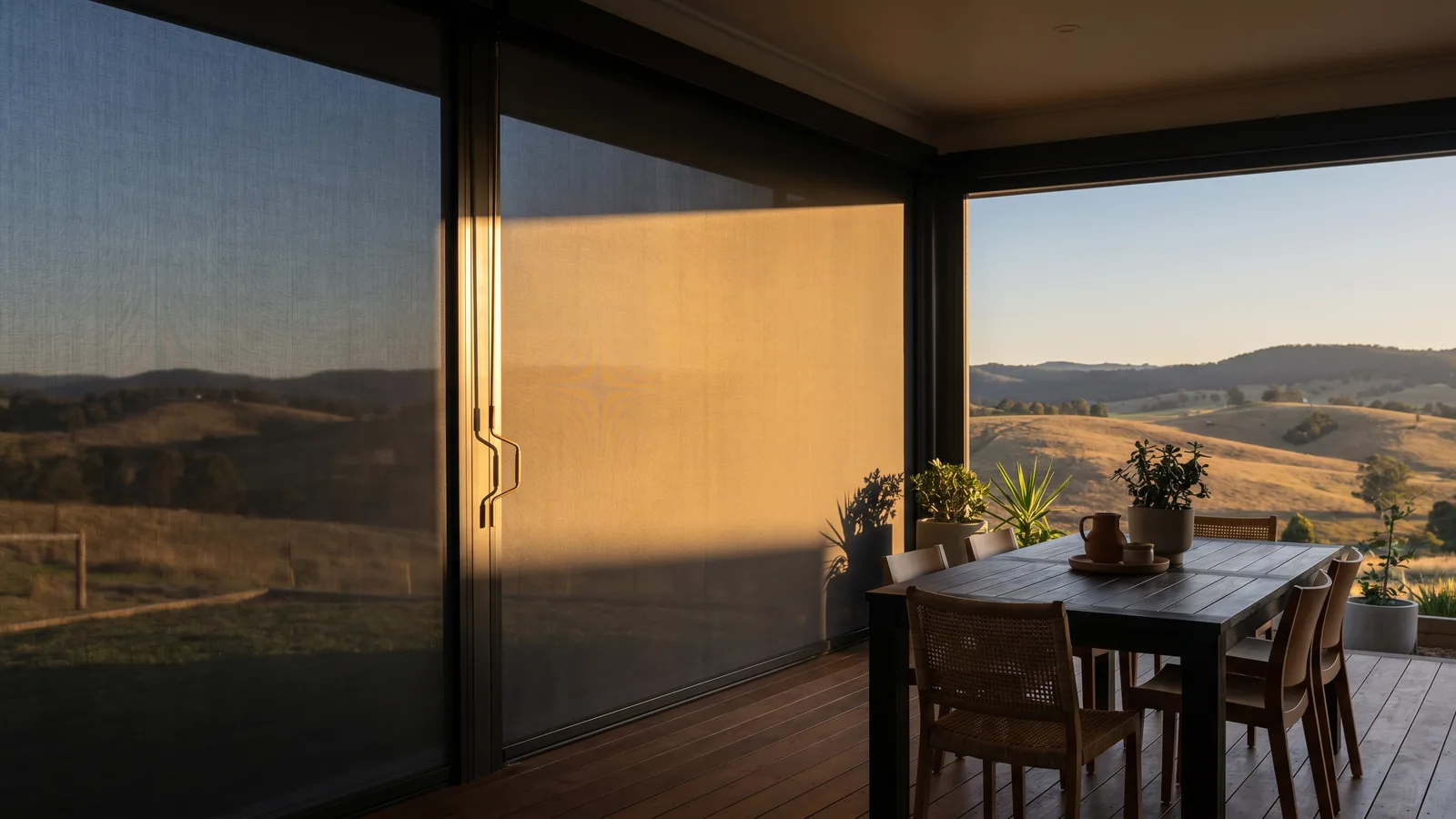
If you only do one thing before the clocks go forward, do this. Go out at the hour you actually use the patio, late in the afternoon or into the evening, and take a photo looking out from where you sit. Note where the light is falling: across the table, in your eyes, or nowhere much.
That one picture shows us your sun angle better than a tape measure does, and it usually answers the awning or blind question before anyone climbs a ladder. If the glare is coming in over glass as well as onto the patio, our guide to stopping Hunter heat before the glass covers the same thinking for windows. When you are ready, book a free measure and quote and bring the photo with you.
Free measure & quote
One visit. Every opening. A written quote.
Send an enquiry and we will arrange your free measure, inside and out, with a recommendation per opening and no obligation.