

C.10 · Safety
Blind cord safety: how to check and fix the cords in a home with young children
Check every corded blind and curtain for a loose loop a child could reach, starting with the oldest, then fix it by going cord-free, by cutting the loop where the blind still works that way, or by securing the cord out of reach with a cleat or a tension device fixed firmly in place.
If a corded blind or curtain has hung in your home for about 12 years or more, it went up before Australia's installation rule for cords began. That figure is our estimate, and the working is short. The national installation standard commenced on 1 January 2015, and from then to October 2026 is just under 12 years. As Consumer Affairs Victoria puts it, the Commonwealth standard only applies to blinds and curtains installed from 2015 onwards.
So start with the oldest blinds, and bring a tape measure. The standard covers corded blinds and curtains installed in homes from 1 January 2015, other than caravans, mobile homes and boats. Those blinds and curtains must be installed so a loose cord cannot form a loop of 220 mm or longer at or below 1,600 mm above floor level. Whatever the age of the blind, a loop that size hanging that low is the thing to fix.
The check takes about ten minutes, and it's worth doing. According to Consumer Affairs Victoria, unsecured cords cause the strangulation deaths of 1 to 2 Australian children each year.
Our Child-Safe Window Coverings guide covers which coverings suit a child's room. This guide from Essential Blinds is about the cords themselves:
- what the rules ask
- how to check each room
- which fix suits which blind
- what NSW renters can fit
Which of your blinds went up before the rules?
Source: Federal Register of Legislation, Consumer Affairs Victoria
Two national mandatory standards cover blind and curtain cords. Between them they set the installation and labelling requirements for suppliers and installers of corded blinds and curtains. They started at different times.
- Supply. The Trade Practices (Consumer Product Safety Standard, Corded Internal Window Coverings) Regulations 2010 apply to products supplied after 30 December 2010. They cover the warning labels and instructions a blind comes with.
- Installation. The Competition and Consumer (Corded Internal Window Coverings) Safety Standard 2014 commenced on 1 January 2015. It covers where the cord ends up on your wall.
By our count, that leaves a gap of just over four years, from the last day of 2010 to the first day of 2015. In that window a blind came with its warning tag, but no national rule governed how it was fitted.
Don't assume the blinds already in your house meet the rules. Consumer Affairs Victoria says to check every room for looped cords, especially where blinds or curtains were installed before 2015, because older products may not meet current mandatory standards.
Victoria has gone a step further: from 1 December 2025, all Victorian rental properties must have secured cords. That rule is Victoria's only. It does not apply in NSW.
What a cord fitted to today's rule looks like
Source: Federal Register of Legislation, NSW Government
Three measurements do most of the work in the 2014 installation standard.
The loop. A loose cord cannot form a loop of 220 mm or longer at or below 1,600 mm above floor level.
The cleat. A cleat used to secure a cord must be at least 1,600 mm above the floor. The reason sits in the supply rules, which require the instructions to state that a child can unwind a cord from a cleat.
The cord guide. The standard sets a test for any cord guide that sits low. No part of a cord guide may sit below 1,600 mm unless it stays firmly fixed to the wall or structure under a 70 N pull for 10 seconds and the cord is secured or tensioned to prevent a loop of 220 mm or longer. As our own rough conversion, at about 10 N per kilogram, 70 N is the pull of a 7 kg bag hanging off it.
Two things on the wall finish the job:
- The installer must attach a label with the name and contact details of the person or company responsible for the installation.
- Warning labels or swing tags supplied with the product must not be removed.
Remember the 1,600 mm line. Below it, a cord must not form a 220 mm loop. Above it is where a cleat belongs.
How to check each room
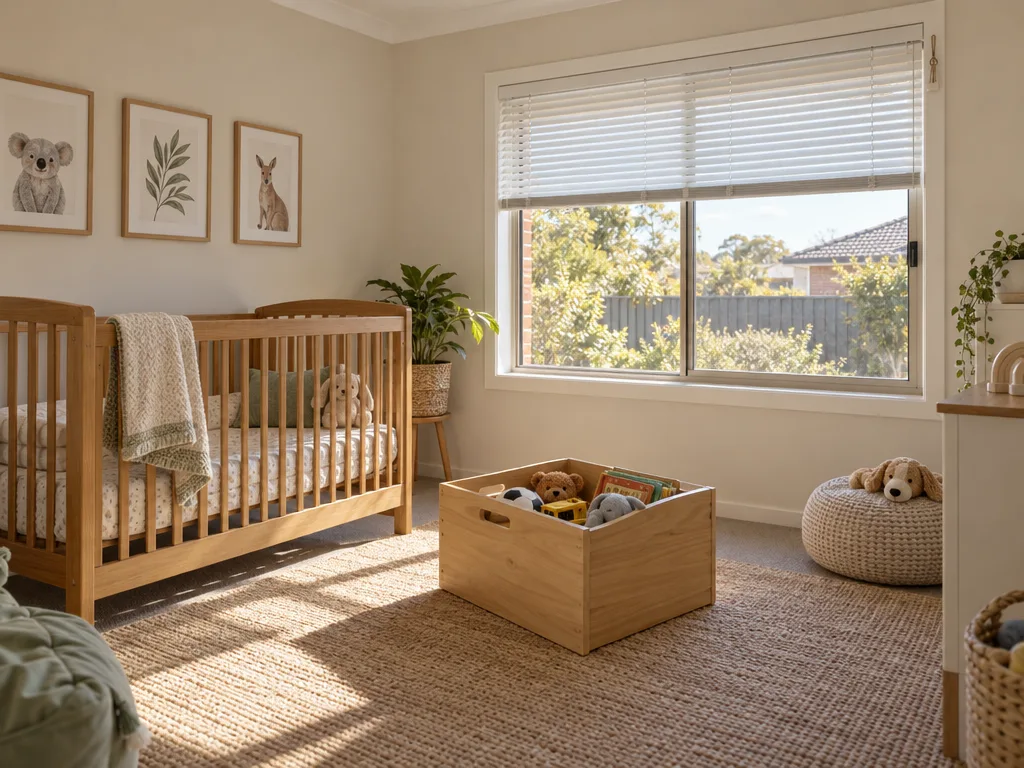
NSW Fair Trading gives three steps for homes with children, particularly under six:
- Move furniture, cots and beds away from cords.
- Check all cords wherever children are present.
- Make loose cords safe with safety devices, or cut the cord loop and attach a tassel to each strand.
Western Australia's regulator is more specific about furniture. It says to keep cots, beds, highchairs and playpens away from windows where children can reach a cord, along with sofas, chairs, shelves and bookcases. Anything a child can climb brings a high cord within reach.
Here's how we'd run the check at home, window by window:
- Stick a strip of masking tape on the wall at 1,600 mm.
- Pull each cord or chain gently down and away from the window, the way a curious toddler would.
- Measure any loop that forms below the tape.
- Look at every cleat and tension device. Is the cleat above the tape, and is the device screwed firmly to the wall or frame?
- Note which blinds you know went up before 2015, and give those the closest look.
Room-by-room cord check
Rooms to tick
Homes that don't usually have children deserve the same walk-through before young visitors arrive, such as a grandparent's place with older blinds. In the eastern division, the summer school holidays run Friday 18 December 2026 to Wednesday 27 January 2027.
Fixing a loose cord: which fix suits which blind
| Your blind | Fix | Check first |
|---|---|---|
| Any corded blind or curtain | Replace it with a cord-free blind (wand, cordless or motorised) | General advice: no loop left to manage |
| A blind that still works with its loop cut | Cut the loop and knot a new tassel onto each end | Check the blind will still work with cut cords and that cutting won't void the warranty |
| A vertical blind or curtain whose pull-cord needs a continuous loop | Don't cut it. Fit a safety device that secures the cords out of children's reach | Fix the device firmly to the wall or frame so a child can't remove it. Below 1,600 mm, a cord guide must stay fixed under a 70 N pull for 10 seconds, with the cord tensioned so no 220 mm loop forms |
| Any cord you wind up | Wind it around a cleat at least 1,600 mm above the floor | A child can unwind a cord from a cleat, which is why the cleat goes high |
Our view at Essential Blinds is that the best fix takes the loop away rather than managing it. Work down this list in order.
1. Go cord-free. A blind run by a wand, by hand or by a motor has no loop to manage, so there is nothing to recheck when the furniture moves. It's the most work up front. In a nursery, it's the option we'd look at first.
2. Cut the loop, where the blind allows. Before you pick up the scissors, NSW Fair Trading says to check the blind will still work with cut cords and that doing so won't void the warranty. Then cut just above the tassel, remove any tassel and equaliser buckle, then knot a new tassel onto each end.
Cutting a cord loop (only where the blind still works with cut cords and the warranty allows)
Source: NSW Government
Cutting won't work on every blind, because pull-cords on certain vertical blinds or curtains need a continuous loop to work and cannot be cut. Those need a safety device that secures the cords out of children's reach. If you can't tell whether a loop is continuous, leave it uncut and use option 3.
3. Secure the cord. You have two ways to do it:
- Cleat. Wind the cord around a cleat at least 1,600 mm up, high for the reason above.
- Tension device. WA's regulator says to fix tie-downs and tension devices firmly to the wall or frame so a child can't remove them. Below the 1,600 mm line, it needs to meet the cord guide test in the section above.

What your supplier or installer should leave behind
What should come with a corded blind or curtain
The supply regulations list what a corded blind or curtain must come with:
- a warning label on the retail packaging
- a warning label or swing tag on the cord
- installation instructions
- any components the instructions specify as necessary for cord safety
The cord tag says young children have died wrapping loose cords or chains around their necks. It tells you to secure cords with cord guides or wind them around a cleat, and to move cots and furniture away. It ends with "Do not remove this label". Leave it on.
The instructions must also state that a cord guide installed lower must be designed so a child cannot remove the cord.
If someone installs the blind for you, look for their name and contact label as well. Keep the instructions with your house papers, so whoever moves the furniture next knows how the cord is meant to sit.
Renting in NSW: can you fit cord safety devices yourself?
| Question | NSW answer |
|---|---|
| Cleats or cord guides to secure blind or curtain cords | A minor change the landlord is not permitted to refuse, except as below |
| Installing or replacing internal window coverings such as curtains or removable blinds | Same |
| Window safety devices for child safety | Same |
| Where the rule doesn't apply | Properties on the loose-fill asbestos insulation register; heritage properties |
| Where restrictions apply | Strata, residential land lease community and social housing properties |
| Who pays | The tenant, unless the landlord agrees to pay |
| If approval is refused | The tenant can go to NCAT |
| Victoria's rental rule (secured cords from 1 December 2025) | Victoria only; it does not apply in NSW |
Subject to the exceptions in the next paragraph, a NSW landlord is not permitted to refuse consent to certain minor changes. The list includes:
- installing cleats or cord guides to secure blind or curtain cords
- installing or replacing internal window coverings such as curtains or removable blinds
- fitting window safety devices for child safety
You still ask for consent. Unless the landlord agrees to pay, the tenant pays.
The exceptions matter:
- The rule doesn't apply to properties on the loose-fill asbestos insulation register or to heritage properties.
- Restrictions also apply to strata, residential land lease community and social housing properties.
- If approval for a minor change is refused, the tenant can go to NCAT.
What about pets?
Cats bat at anything that swings, and dogs chew what they can reach. Treat a pet the way you would a toddler:
- wind cords up high
- cut loops where the blind allows
- keep cord ends and chains off the floor and away from beds and couches
The same fixes above cover both.
If a cord is unsafe or a child is hurt
If a blind or curtain is unsafe, tell the supplier and report it to Product Safety Australia. If a child is injured, call 000 or see a GP.
The cord check at a glance
Source: Federal Register of Legislation, NSW Government
Five figures carry the whole check: the 1,600 mm line, the 220 mm loop, the 70 N cord guide test, and the two start dates that tell you which rules a blind went up under. Keep them on the fridge or in your phone, and run the check again whenever a cot or a couch moves.
When you'd rather replace the blind than fix the cord
Some blinds aren't worth retrofitting: an old venetian with frayed cords, a vertical with a loop you can't cut, or a nursery window you'd rather have nothing hanging from at all.
If that's where you've landed, book a measure and quote through our enquiry page, and ask about cord-free operation for the rooms where children sleep and play. You can browse our interior blinds and curtains first. Our guide to choosing blinds for Hunter heat, older homes and children covers the other things worth weighing at the same time.
Sources
- NSW Government, Blind and curtain safety: https://www.nsw.gov.au/legal-and-justice/consumer-rights-and-protection/safety/other-consumer-products/blind-and-curtain-safety
- Competition and Consumer (Corded Internal Window Coverings) Safety Standard 2014: https://www.legislation.gov.au/F2014L00363/asmade/2014-03-28/text/original/epub/OEBPS/document_1/document_1.html
- Trade Practices (Consumer Product Safety Standard, Corded Internal Window Coverings) Regulations 2010: https://www.legislation.gov.au/F2010L01930/asmade/2010-07-09/text/original/epub/OEBPS/document_1/document_1.html
- Consumer Affairs Victoria, Are your curtain and blind cords safe?: https://www.consumer.vic.gov.au/latest-news/are-your-curtain-and-blind-cords-safe
- NSW Government, Making changes to a rental property: https://www.nsw.gov.au/housing-and-construction/rules/making-changes-to-a-rental-property
- Consumer Protection WA, Blind and curtain cord safety: https://www.consumerprotection.wa.gov.au/blind-and-curtain-cord-safety
- NSW Government, School holidays: https://www.nsw.gov.au/about-nsw/school-holidays
- Pictures in this guide are illustrations, not photos of our jobs.
Free measure & quote
One visit. Every opening. A written quote.
Send an enquiry and we will arrange your free measure, inside and out, with a recommendation per opening and no obligation.