

C.12 · 03 awnings & outdoor
Outdoor blinds in wind and storms: when to secure them, and how
Secure outdoor blinds and awnings when the sky darkens and the wind starts to rise, not when a warning arrives, because a storm can build with little or no warning; your maker's manual says whether yours goes fully up or is locked fully down in high wind, and in extreme weather Ziptrak says it goes all the way up.
The moment to deal with an outdoor blind is the first dark sky, not the first warning. Here is the working behind that.
BOM's Severe Weather Warnings can arrive from an hour to 36 hours ahead. Waiting for an official alert before acting is risky, because you may not always receive one. And once the wind is up, the maker guidance says to avoid operating motorised blinds in high winds.
Put those three together and the safe time to secure a blind can be an hour or less. Sometimes nothing official prompts you at all. That window closes as soon as the wind arrives.
That reading is ours. It is also why, at Essential Blinds, we would rather you secured the blind too early and felt a bit silly than waited.
When should you roll up outdoor blinds before a storm?
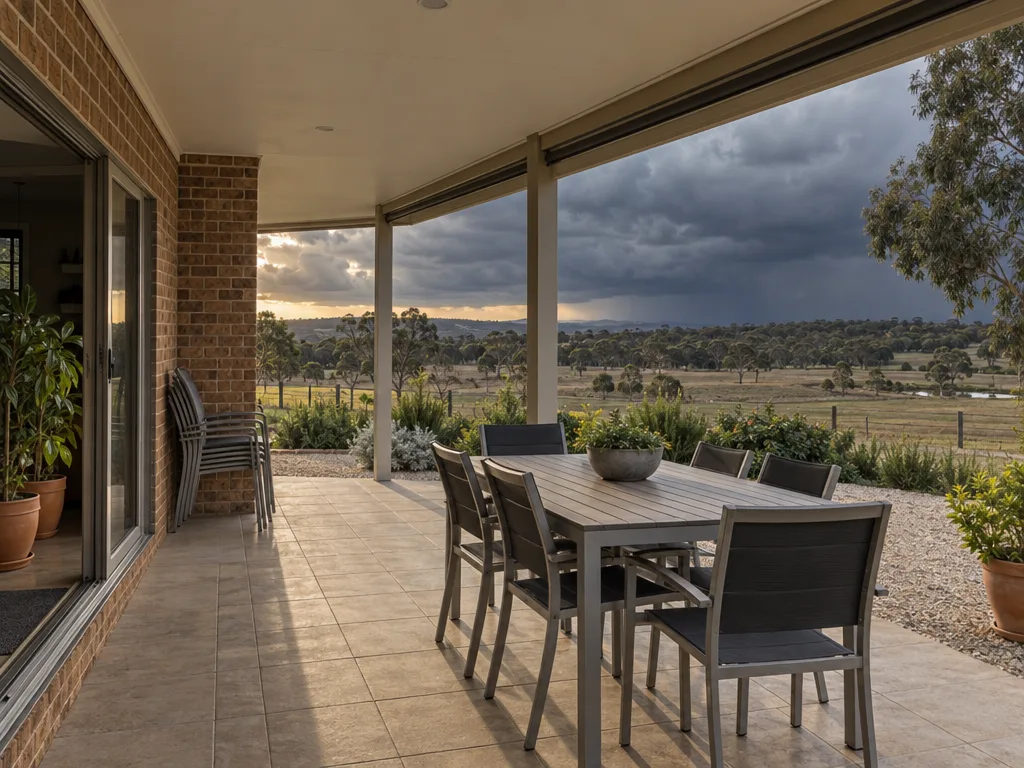
When the signs start, and before the wind does. NSW SES lists the natural signs of a storm as gathering heavy clouds, darkening skies, increasing winds, thunder, lightning and heavy rain. Treat the first one you notice as your cue for the blind, the awning and anything loose on the patio.
Storm season in NSW falls between September and April, although a major storm can happen at any time of the year. So keep the habit all year, not just over summer.
"Secure" means different things for different blinds. Most go fully up. Some track-guided blinds can also be lowered fully and locked in high wind, but in extreme weather even those go fully up. The section on blind types below has the detail.
Source: NSW SES, During a storm, Ziptrak, track-guided tips, Ziptrak, cable-guided tips
How much warning will you get?
Sometimes plenty, sometimes very little. BOM's Severe Weather Warnings cover sustained gale-force winds of 63 km/h or more and damaging gusts of 90 km/h or more. Their lead time runs from an hour to 36 hours.
Thunderstorms are harder to pin down. BOM says severe thunderstorms can be quite localised and can develop and fade quickly, so the exact location is hard to predict even a short time out. The storm over your street can be smaller and faster than any warning area.
Give yourself a second set of eyes. NSW SES suggests the Hazards Near Me app, with watch zones set for severe weather and flood. Set one on home, and one on anywhere else you leave a blind down.
Source: Bureau of Meteorology, warning services, NSW SES, During a storm
What wind speed is too much for outdoor blinds?
No single number covers every outdoor blind. The limit belongs to your blind's maker and to how it was fitted, so it lives in your manual, not in a rule of thumb borrowed from someone else's product. One maker says the wind resistance of an outdoor blind depends on professional installation.
What BOM's numbers do give you is a way to read the warnings. A thunderstorm is severe if it brings hail 2 cm or larger, damaging wind gusts of 90 km/h or more, tornadoes, or heavy rain that may cause flash flooding. It is "very dangerous" at giant hail of 5 cm or more, destructive gusts of 125 km/h or more, tornadoes or intense rainfall.
These are storm categories, not ratings for a blind. If a warning mentions any of them, your blind should already be secured.
Source: Bureau of Meteorology, warning services
Fully up, or down and locked? It depends on the blind
"During high winds, always leave blinds fully retracted (all the way up) or fully lowered and locked. In extreme weather, fully retract your blinds."
For track-guided blinds, Ziptrak's guidance gives two options in high wind and one in extreme weather. In high wind, the blind can be fully retracted (all the way up) or fully lowered and locked. In extreme weather, it goes fully up.
Cable-guided blinds are stricter. For high wind Ziptrak says fully retracted or fully lowered; in very strong winds, storms or severe weather, cable-guided blinds should be fully retracted.
Track-guided blinds can be hard to operate in wind, and the same guidance suggests easing the fabric with gentle hand pressure rather than forcing it. That is one more reason to move early.
For folding-arm awnings, straight-drop blinds and other makes, follow the maker's manual. It sets the limits for that product, and it is the document to keep somewhere you can find it in a hurry.
| Blind type | In high wind | In storms, severe or extreme weather | Operating in wind |
|---|---|---|---|
| Track-guided (Ziptrak guidance) | fully up, or fully lowered and locked | fully up | avoid running a motor in high wind; blinds can be hard to move in wind, ease the fabric with gentle hand pressure |
| Cable-guided (Ziptrak guidance) | fully retracted or fully lowered; fully retracted in very strong winds | fully retracted | correct installation is crucial in windy conditions |
| Folding-arm awning | follow your maker's manual | follow your maker's manual | follow your maker's manual |
| Straight-drop and other makes | follow your maker's manual | follow your maker's manual | follow your maker's manual |
Source: Ziptrak, track-guided tips, Ziptrak, cable-guided tips
Are some outdoor blinds better for wind and rain?
The fabric and the fitting both matter. Tighter mesh weaves block more wind and rain, and open weaves allow more airflow. On an exposed western patio that trade-off is worth thinking through before you choose.
Fitting matters as much as fabric. Ziptrak says its blinds must be installed by an experienced installer of its products, and fabricated and installed to its manuals to keep the warranty valid.
One detail is easy to miss: Ziptrak says the fabric on its blinds is not covered by the Ziptrak warranty. On any blind you are quoted, ask who covers the fabric and who covers the hardware.
If you are still deciding between an outdoor blind and an awning, our guide Outdoor Blinds or Awnings: Shade for Spring Evenings walks through that choice.
Source: Ziptrak, track-guided tips
A storm routine for outdoor blinds: before, during, after
Before. Watch the forecast and the sky. Then secure the blind the way its manual says: fully up, or locked fully down where that is allowed, and fully up when the weather turns extreme. Our advice: retract at any BoM severe thunderstorm or Severe Weather Warning.
Clear the blind's path. NSW SES says to secure loose items such as outdoor furniture or a trampoline, and to bring items indoors where possible. Pot plants and chairs sitting under a blind also get in its way when it moves.
Close the house up as well. BOM's advice is to secure external doors and windows and draw curtains. SES adds a job for a calm day: inspect windows and doors and check they seal properly.
During. Stay in. The safest place during a storm is inside, away from windows. If a blind is still down when the wind arrives, leave it rather than go out and wrestle it.
Don't climb up to take a fixed outdoor blind down, before or during a storm. Removing one is a job for a trained installer.
After. Look before you use it. The next section covers the checks.
One trade-off to know about: the maker guidance says to avoid rolling up blinds when the fabric is wet, because trapped moisture may cause mould. A storm comes first. If you had to roll it up wet, our suggestion is to lower it again to dry once the wind has gone.
Before
During
After
Source: NSW SES, During a storm, NSW SES, Prepare your home, Bureau of Meteorology, warning services, Ziptrak, track-guided tips, Ziptrak, cable-guided tips
Motorised blinds, empty houses and power cuts
A motor makes the blind easy to forget. If storms are in the forecast and you are heading out, retract the blind before you leave. Nobody will be home to do it when the sky turns.
Wind is the reason. Ziptrak advises you to avoid operating motorised blinds in high winds, because wind pressure on the fabric affects how the blind moves. Pressing the remote mid-gust is the wrong time.
Storms and power cuts often arrive together. Ask your installer how the manual override on your blind works, then practise it on a calm day. Show anyone who minds the house while you are away, too.
Checking outdoor blinds after a storm
Before you run the blind again, walk along it. Check that the tracks or cables are straight, the brackets are firm on the wall, and the fabric has no tears or debris caught in it.
Cable-guided blinds have a simple tension test. With the blind fully retracted, press the cable outward, and if it flexes more than 30 mm, contact the retailer.
If a blind feels sticky afterwards, don't reach for an oil-based spray such as WD-40. Ziptrak says not to use oil-based lubricants such as WD-40 on its blinds, because they can damage the spline tape. Other makers' advice may differ, so follow your blind's manual.
Source: Ziptrak, cable-guided tips
If there is damage, NSW SES says to contact your insurer as soon as possible to lodge a claim. Better still, check before the season peaks. SES says to make sure home and contents insurance is adequate and up to date, with cover for the events specific to where you live. Read your policy documents, and ask your insurer directly whether blinds and awnings are covered.
Why this storm season deserves the extra care
NSW SES's storm season page says that in the last storm season it responded to more than 23,416 incidents. Roughly 7,000 involved fallen trees and more than 6,500 involved leaking and damaged roofs.
By our estimate, those two together make up a little over half of all call-outs. The working: roughly 7,000 plus more than 6,500 is about 13,500, and 13,500 divided by 23,416 is around 58%. Wind and water are what bring them in.
Source: NSW SES, Storm Season
This summer leans wet and hot in our part of NSW. BOM's outlook issued 5 November says rainfall for December to February is likely (60% to over 80% chance) to be above average across much of eastern NSW. It also gives an increased chance (40 to 70%) of unusually high summer rainfall in parts of eastern NSW. Eastern NSW is among the areas with the highest chance, over 70%, of unusually high maximum temperatures.
A strong El Niño is under way, and BOM notes that warmer waters can fuel storms and rain systems. It is just as clear that a strong El Niño does not necessarily mean strong impacts. None of this predicts a storm on your street. It does make this a good season to have the routine down pat.
BOM outlook issued 5 Nov 2026, December to February, eastern NSW
| Measure | Chance | Where |
|---|---|---|
| Rainfall above average | likely, 60% to over 80% | much of eastern NSW |
| Unusually high summer rainfall | increased chance, 40 to 70% | parts of eastern NSW |
| Unusually high maximum temperatures | over 70% (among the highest in Australia) | eastern NSW |
A strong El Niño does not necessarily mean strong impacts (BOM).
Source: Bureau of Meteorology, Climate outlooks, Bureau of Meteorology, ENSO
The storm numbers to keep handy
The figures below are the ones worth remembering. They are BOM's and SES's lines for reading a warning, plus one maker's tension check. They are not a wind rating for any blind.
- NSW Storm Season
- September to April, though a major storm can happen at any time of the year (SES)
- Source: https://www.ses.nsw.gov.au/stormseason
- BOM warnings
- sustained gale-force wind 63 km/h or more, damaging gusts 90 km/h or more, lead time an hour to 36 hours
- Source: https://www.bom.gov.au/resources/learn-and-explore/severe-weather-knowledge-centre/severe-weather-and-coastal-hazard-warning-services
- Severe thunderstorm
- gusts 90 km/h or more, hail 2 cm or larger; "very dangerous": gusts 125 km/h or more, giant hail 5 cm or more
- Source: https://www.bom.gov.au/resources/learn-and-explore/severe-weather-knowledge-centre/severe-weather-and-coastal-hazard-warning-services
- Cable-guided blind check
- contact the retailer if the cable flexes more than 30 mm with the blind fully retracted (Ziptrak)
- Source: https://www.ziptrak.com.au/support/outdoor-cable-guided-tips-and-tricks/
Planning outdoor shade with storms in mind
If you are choosing outdoor blinds or an awning for a Maitland or Hunter patio, ask the storm questions before you decide. How should this blind sit in high wind? How does the manual override work if it is motorised? Which weave suits how exposed the spot is? And who covers the fabric?
Browse the awnings and outdoor blinds range, then book a measure and quote with Essential Blinds and bring that list with you.
Sources
- NSW SES, Storm Season: https://www.ses.nsw.gov.au/stormseason
- NSW SES, During a storm: https://www.ses.nsw.gov.au/during-emergency/during-storm
- NSW SES, Prepare your home: https://www.ses.nsw.gov.au/plan-and-prepare/prepare-your-home
- Bureau of Meteorology, Severe weather and coastal hazard warning services: https://www.bom.gov.au/resources/learn-and-explore/severe-weather-knowledge-centre/severe-weather-and-coastal-hazard-warning-services
- Bureau of Meteorology, Climate outlooks: https://www.bom.gov.au/climate/ahead/outlooks/
- Bureau of Meteorology, ENSO: https://www.bom.gov.au/climate/enso/index.shtml
- Ziptrak, Outdoor track-guided tips and tricks: https://www.ziptrak.com.au/support/outdoor-track-guided-tips-and-tricks/
- Ziptrak, Outdoor cable-guided tips and tricks: https://www.ziptrak.com.au/support/outdoor-cable-guided-tips-and-tricks/
- Ziptrak, FAQ: https://www.ziptrak.com.au/faq/
Free measure & quote
One visit. Every opening. A written quote.
Send an enquiry and we will arrange your free measure, inside and out, with a recommendation per opening and no obligation.