

C.11 · Fabric
Light filtering, blockout or sunscreen blinds: which room needs which for daylight saving evenings
Put blockout where darkness matters (bedrooms, kids' rooms, TV rooms and day sleepers), light-filtering where you want soft daylight and privacy, and sunscreen where glare is the problem but the view is worth keeping, and remember that a darker room is not automatically a cooler one.
NSW daylight saving runs for 26 weeks this season. That is our count of the 182 days between the two dates the NSW Government gives for daylight saving: it started on Sunday 4 October 2026 and ends on Sunday 4 April 2027. So the light at bedtime is a question for half the year, not for one awkward week.
The answer for most homes is to match the fabric to the room. Use blockout where darkness matters, light-filtering where you want soft daylight and privacy, and sunscreen where glare is the problem but the view is worth keeping.
Essential Blinds' view is simple: don't blockout the whole house. One of the reasons the NSW Government gives for daylight saving is to reduce energy consumption by cutting the need for artificial lighting in the evening. A living room sealed in blockout throws that evening light away.
Why does the room feel brighter at bedtime now?
Source: NSW Government, Sleep Health Foundation
At 2am on 4 October, clocks in NSW moved forward to 3am. That gives more daylight in the evening and less in the morning. The sun hasn't changed, but the clock on the bedroom wall has.
Children can be slower to adjust. The Sleep Health Foundation says children can take longer than adults to adjust, and that for younger children it can still be light when they go to bed. For anyone, it can take up to a week to feel back to normal after the October change.
Light in the room matters as well as light outside. The same foundation notes that being in a brightly lit environment can reduce evening levels of melatonin, the hormone that helps you sleep.
Then there is the low sun. Your Home says the low morning and afternoon summer sun on east- and west-facing windows is hard to shade. In many Hunter homes, that west light lands in the living room or kitchen right when the family is cooking, eating and watching TV.
Which blind goes in which room?
Source: Your Home, Sleep Health Foundation
Walk through the house in the evening and ask one question per room: what job does this window need to do after dinner?
Bedrooms. Blockout, because the job is darkness at bedtime. Look at mornings as well. The Sleep Health Foundation advises getting natural daylight early in the day. Its daylight saving advice also includes making the bedroom as bright as possible when you first wake. That means you want a blind that opens fully and easily.
Kids' rooms. Blockout again, since younger children may be going to bed in daylight. This is also the room where cords matter most. Corded blinds and curtains must be installed so a loose cord cannot form a loop of 220 mm or longer at or below 1,600 mm above floor level. Blinds fitted before 2015 may not meet current mandatory standards. Our blind cord safety guide shows how to check them, and the child-safe window coverings page covers the options.
TV and media rooms. Blockout or a dual blind, so evening sun does not wash out the screen.
Living rooms and kitchens. Light-filtering, so the evening light still does its work while glare and prying eyes are softened. On a hard west window, sunscreen keeps the view.
Home offices. Light-filtering or sunscreen, to take the glare off a monitor without switching on the overhead light at 4pm.
Day sleepers and shift workers. Blockout, whatever the room was meant for.
Light filtering, blockout or sunscreen: what is the difference?
| Fabric | What it does | Rooms it suits | Watch for |
|---|---|---|---|
| Blockout | designed to stop light passing through the fabric | bedrooms, kids' rooms, TV rooms and day sleepers | light at the edges, so fit matters |
| Light-filtering | softens and spreads daylight and gives privacy without a dark room | living rooms, kitchens and offices | won't darken a bedroom for a bedtime while it is still light |
| Sunscreen | an open weave that cuts glare and keeps the view out by day | living areas with a view, offices and sunny windows | at night with lights on inside, people outside can see in |
Source: Sleep Health Foundation, Sleep Health Foundation
In plain terms, the three fabrics do three different jobs.
Blockout is designed to stop light passing through the fabric. It suits sleep, screens and day sleepers.
Light-filtering softens and spreads daylight. It gives you privacy without turning the room dark.
Sunscreen is an open weave. It cuts glare and lets you see out by day. At night, with the lights on inside, people outside can see in, so it usually needs a second layer where night privacy matters.
Exact openness and light levels vary from one fabric to the next, even within a type. Ask to see samples against your own window, ideally in the evening light you are trying to manage. For the full comparison, including sheers, see our guide to blockout, light-filter or sheer fabrics.
Does a darker blind keep a room cooler?
Source: Your Home, glazing, energy.gov.au, Your Home, shading
Not by itself. Light and heat are separate jobs, and a dark room is not automatically a cool one.
For heat, the Australian Government advises close-fitting lined curtains or blinds with a light-coloured "block out" backing and tightly woven material. That guidance also says the covering should reach the floor and wrap to the wall on each side of the window. The ACT Government gives similar general guidance: fit honeycomb blinds snugly, and attach "block-out" backing to a curtain rather than bonding it.
Windows are where the heat comes in. Your Home puts it at up to 87% of a home's heat gained. Energy.gov.au says almost 90% of heat gain, and up to 40% of heating energy lost.
Shading the glass from outside does the most. Effective shading can block up to 90% of the heat from direct sun. Shading the glass matters because re-radiated heat cannot pass back out through glass easily. For east and west windows, Your Home names adjustable vertical shading such as external blinds as the best option. Our guide to inside or outside heat control and the awnings and outdoor blinds range pick up from there.
Going too dark has a cost too. Your Home notes that if tint or window film is too dark, the low light level may lead you to switch on lights. The same logic applies to a house blacked out room by room.
The warm-weather routine from energy.gov.au is to close coverings during the day and open them at sunset to let the evening breeze through. In a child's bedroom, the blockout can then come down at bedtime.
How do you stop light getting round the blind?
Source: Sleep Health Foundation
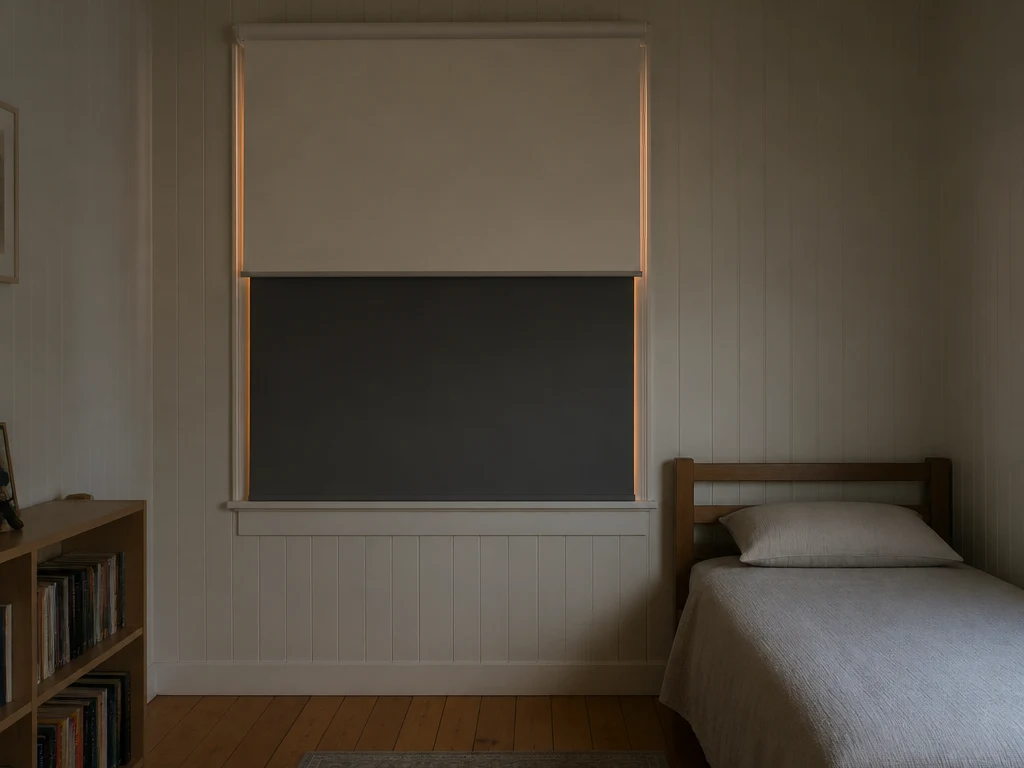
A blockout fabric only darkens the room as well as it is fitted. Most bedtime glow comes in at the sides, the top and the sill.
Whether a blind sits inside the window recess or over the frame changes how much light slips past. That choice is set out in our guide to reveal fit or face fit. Curtains that reach the floor and wrap to the wall, as the energy guidance describes, also close those edges. Browse the curtains range if that suits the room.
Some rooms need daylight in the afternoon and dark at 7pm, such as a nursery, a TV room or a spare room that doubles as an office. For those, a dual blind puts a blockout layer and a light-filtering layer on the one window, so each job has its own fabric. The interior blinds range is the place to start.
Daylight saving and your windows at a glance
- Started Sunday 4 October 2026, 2am AEST, clocks forward to 3am
- Source: NSW Government
- Ends Sunday 4 April 2027, 3am AEDT, clocks back to 2am
- Source: NSW Government
- Up to a week to feel back to normal after the October change
- Source: Sleep Health Foundation
- Almost 90% of a home's heat gain through windows
- Source: energy.gov.au
- Effective shading can block up to 90% of the heat from direct sun
- Source: Your Home
Here are the key facts in one place: the season's two dates, the settling-in week, and the two figures that explain why the glass itself matters for heat. If you are choosing coverings for several rooms at once, our whole-house schedule guide helps you order the job, and the earlier guide to choosing blinds for Hunter heat, older homes and children covers the wider picture.
Getting the right fabric in each room
Start with the room that bothers you most at 7pm. For many families that is a child's bedroom or the TV room facing west.
Then book a measure and quote with Essential Blinds. Ask to see blockout, light-filtering and sunscreen fabrics side by side against your own windows, and talk through which rooms need darkness, which need daylight, and which need both.
Sources
- https://www.nsw.gov.au/about-nsw/daylight-saving
- https://www.sleephealthfoundation.org.au/sleep-topics/daylight-saving-and-sleep
- https://www.sleephealthfoundation.org.au/sleep-topics/sleep-hygiene-good-sleep-habits
- https://www.energy.gov.au/households/windows
- https://www.climatechoices.act.gov.au/energy/energy-efficiency/window-glazing-or-treatments
- https://www.yourhome.gov.au/passive-design/glazing
- https://www.yourhome.gov.au/passive-design/shading
- https://www.nsw.gov.au/legal-and-justice/consumer-rights-and-protection/safety/other-consumer-products/blind-and-curtain-safety
- https://www.consumer.vic.gov.au/latest-news/are-your-curtain-and-blind-cords-safe
Free measure & quote
One visit. Every opening. A written quote.
Send an enquiry and we will arrange your free measure, inside and out, with a recommendation per opening and no obligation.